


THE FIRST IS IN THE GULF AND THE SECOND IN THE ARAB REGION QATAR FOUNDATION FOR SOCIAL WORK IN PARTNERSHIP WITH THE UN COMMISSION LAUNCHES THE INITIAT
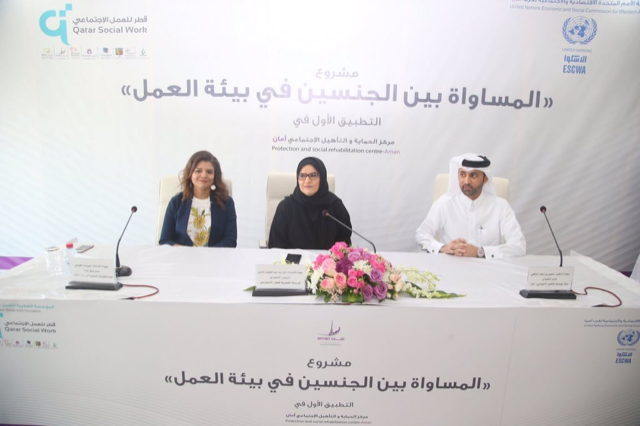
On Thursday, October 10, Qatar Foundation for Social Work and the United Nations Economic and Social Commission for Western Asia (ESCWA) will launch the 'Gender Equality and Women's Empowerment in the Working Environment' initiative as part of Qfsw's advisory status with the United Nations Economic and Social Council (ECOSUK).
The initiative is the first accredited international framework to measure the compatibility of organizations' regulations with women's empowerment mechanisms. The initiative is launched as the first stage of the Center for Protection and Social Rehabilitation (Aman), followed by the rest of the centers under the umbrella of Qatar Foundation for Social Work,
The background of the initiative:
This initiative is based on the concept of partnership and gender integration, allowing men and women to discover their abilities and acquire skills to employ these abilities in new roles, and aims to integrate gender into work and develop the relationship between women and men to achieve the principle of integration and equality, Justice and equity in equal opportunities for both Genders to achieve the principle of social justice.
About the initiative:
The initiative aims to implement an action plan to achieve gender equality and women's empowerment at the level of national organizations, integrate gender equality into the work environment, support efforts to promote women, as well as create a working environment for gender equality.
The initiative plan includes 15 performance indicators. Qatar Foundation for Social Work, represented by Aman Center as a first stage, is interested in implementing this plan as a model step to strengthen the foundations of work in accordance with the framework of gender equality in order to provide the best social services and to conduct an experiment in which to build at the national and regional level to achieve Equality in national institutions, as long-term aims to support national mechanisms related to promoting and empowering women to be able to work in National and governmental Organizations to integrate the concept of Gender Equality at work.
UN experience
ESCWA has been ranked as the best organization within the United Nations out of 72 organizations in terms of success in implementing the plan. Technical expertise and lessons learned from the ESCWA experience help in supporting the national efforts of Arab countries in enhancing administrative efficiency and the optimal exploitation of human energy, and in supporting gender equality and women's empowerment at various levels and in various fields within the national organs. The initiative was the first of its kind in the Arab Gulf region and the second among Arab countries, following the regional workshop held in November 2016, the Jordanian National Committee for Women's Affairs was the first to formally submit to ESCWA a request for support to test the Arab framework.
Hence, ESCWA designed the 'Integrate gender equality perspective within public Sector' project and presented it to the Member States during the seventh session of the Women's Committee in Muscat in January 2016. The members have approved this project, and ESCWA has declared its readiness to provide financial and technical support to test this framework at the level of the national mechanism for the advancement of women in a Member State, based on the official request of that state.
The technical guide to the Action Plan on Gender Equality and Women's Empowerment was translated into Arabic, and a regional workshop was held to modify the technical guide to suit the needs of Arab states, and to reach a unified Arab framework for measuring efforts towards gender equality in public institutions, in the field of institutional capacity-building, promoting a culture that supports gender equality and women's empowerment.
The United Nations Chief Executive Board on Coordinating Gender Equality and Women's Empowerment Policy has developed the 'Action Plan on Gender Equality and Women's Empowerment across United Nations Organizations', which is an accountability framework aimed at building and disseminating Common understanding to the cause of gender equality and women's empowerment within the system. It includes 15 performance indicators divided by the six policy areas: accountability, results-based management, supervision, human and financial resources, capacity-building, coordination and knowledge and information management. The United Nations Economic and Social Commission for Western Asia (ESCWA) is working to move the plan and disseminate its use within institutions.
ESCWA has developed a project to integrate the gender equality perspective into public institutions by developing plans and policies that ensure the institutionalization of the organization's gender equality perspective and reviewing procedural systems to improve the working environment.
Gender equality in the workplace: 10 global facts
Women's contribution to the labor force has stagnated, falling from 57% in 1990 to 55% in 2012, with the average number of women earning 10% to 30% less than working men, and in only five of the 114 countries for which data are available, women have achieved or exceeded the level of equality with men in occupations such as legislators, senior officials, managers, (Colombia, Fiji, Jamaica, Lesotho, the Philippines), and women spend twice of the time as much as Men do in family tasks such as care and domestic work. There are 128 countries have at least a gender discrimination, which means that women and men cannot perform in the workplace in the same way, and in 54 countries women face five or more types of legal discrimination. All over the world, there is a 9% difference between women and men in terms of having an account with an official financial institution, and there are more than one in each three women has experienced physical or sexual violence by a partner or another person, and from 2010 to 2012, 42 countries recorded gender gaps in secondary school enrolment rates of more than 10%, and one in each three girls married before reaching age of Eighteen.
About Aman Center:
Established by Her Highness Sheikha Moza bint Nasser, in 2013, it is concerned with the protection and rehabilitation of women and children victims of violence and domestic services and their reintegration into society, Aman center is working under the umbrella of Qatar Foundation for Social Work.
About ESCWA:
The Economic Commission for Western Asia (ESCWA) was established on 9 August 1973 by Resolution 1818 (D-55) of the United Nations to stimulate economic activity in member countries, promote cooperation among them and promote development so that ESCWA can be part of the secretariat. Working under the auspices of the Economic and Social Council, ESCWA provides a framework for formulating and harmonizing policies, a platform for meeting and coordination, a home of expertise and knowledge, and an information observatory, Coordinating its activities with the main departments and offices of The United Nations Headquarters, with specialized agencies, international organizations and regional bodies such as the Arab League and its subsidiaries, and the Gulf Cooperation Council, with 18 countries, including Qatar, as a member.